The venetian blinds buzzed as small gusts of wind passed through the open window, and gently awakened Frank from his dreamless sleep. He yawned and looked around the room, searching for something familiar. Whether it had been a full night’s sleep, or just a short nap, he never seemed to recognize his surroundings when he first woke up. It had been that way for as long as Frank could remember. Across the hall, a flashing light and its chirping partner began in unison as if they too had just been roused by the buzzing blinds.
Frank stood up and stretched, then sat back down on the edge of his bed. He looked at the photographs hanging on the doors of his chifforobe. The pictures gently waggled on their hinges of tape in the stirring air. Time had curled them into faded green and yellow troughs. He studied the images of his children, grandchildren and great-grandchildren, but they failed to become little more than vaguely familiar to him. He knew that he should recognize them, and felt ashamed because he could not.
His mouth was dry as cotton. He smacked his lips and reached for the styrofoam cup sitting on his bedside table. The ice water rattled and slushed when he grasped the cup with his shaky hand. The straw scratched in the cup’s cover like a whistling violin string as he slowly sucked the water over his parched tongue.
“Aah… That hit the spot!” He licked the lingering drops across his lips for good measure, smiled at the cup and set it back on the table. The light across the hall continued blinking rhythmically with its chirping companion.
Nurse Peggy’s rubber soled shoes squeaked on the freshly polished floors, announcing her arrival. “Hello Mr. Anders! How’s my favorite, sweet, handsome man doing this morning?” She jiggled the pills, Frank’s morning dose, in a small plastic cup.
“Well,” he chuckled, “I just woke up and nobody was throwing dirt in my face. I guess I’m doing okay … um …” He winked and nervously smiled. He couldn’t remember her name.
“What would I do without you to brighten my day Frank?” she laughed.
“Well …” Frank shrugged his shoulders. “I expect you’ll get by okay.”
She handed his pills to him, along with a fresh cup of water. “I expect we’ll both get by okay after you take your pills for me.”
Frank swallowed his pills and took a long drink of water. “Aah … That hit the spot! I was getting pretty thirsty. I don’t think I’ve had anything to drink all day.”
“Okay honey.” Peggy wiped a little dribble off Frank’s chin. “I’m going to see what’s going on across the hall with Mr. Oswald. I’ll be seeing you later.” Her smile concealed the melancholy she felt for his confusion. Such a sweet man, she thought to herself. The light stopped blinking; the chirping ceased.
Frank leaned over and slipped his swollen feet into his oversized walking shoes. He stood up from his bed, waited until he felt steady on his feet and shuffled over to his window. Dust sprayed and sparkled in the sunlight as he raised the blinds to look outside. The autumn breeze was warm and dry. Each new gust of wind set the Stars and Stripes in motion, flipping and popping atop the flagpole in the courtyard. The metal flag snap on the halyard banged against the pole. Clang, clang. Clang, clang …
Frank pulled a chair alongside the window and sat down. The warmth of the sun on his face softened his wakefulness. His eyelids were becoming heavy already, and slowly covered his Swedish blue eyes. Another brief gust brushed wisps of his hair, tingled his scalp, and tried to stir old memories. Some people standing outside saw him sitting by his window and waved, but he did not see them. Frank had drifted into the hypnotic murkiness that is the gateway to sleep.
Clang, clang. Clang, clang …
***
The clanging bell perched on the front of the Union Pacific locomotive reminded Frank of the bell that had called him to school just a few years ago. What he heard now was a call to war. Steam hissed, smoke billowed. The softness of Mary’s parting kiss lingered on his lips. “I’ll be back before you know it,” he told her. Mary’s hands slipped away from his shoulders as he turned and boarded the train.
From his window seat Frank could see people waving little flags, mothers capturing their tears in lace handkerchiefs, fathers fighting back tears that would betray their stoicism, sweethearts holding each other – all hoping for a safe return of their soldiers, marines and sailors. The big steam engine was poised like a Belgian draft horse eager to pull its load.
“All aboard!” the conductor shouted. He made one final visual check up and down the line of cars to make sure they were clear to proceed. He raised his extended arm up and down, the highball signal to the engineer that it was time to go.
Frank’s ears were filled with two long mournful wails from the train’s whistle. He felt the shudder of the locomotive as its big steel wheels churned and slipped against the rails, grasping for traction. The steel horse lurched forward, and each coupler banged in succession to the last car. Frank leaned out of the window, and waved to Mary. She was standing on her toes and waving back to him. They waved until they lost sight of each other.
The train picked up speed and rumbled away from the platform. Black smoke belched from the locomotive’s chimney and washed over the cars in tow. Soot swirled through the open passenger car windows. Some of the fine black powder peppered the shoulder of Frank’s khaki shirt and settled next to Mary’s evaporating tears.
Frank watched the backyards of houses pass by. Children ran to the fences and waved at the passing train. Women held clothespins in their lips as they hung their laundry out to dry. Startled birds flew away from their perches on the phone lines that paralleled the pathway of the train.
***
When Peggy stepped out of Mr. Oswald’s room, she saw Frank vacantly staring skyward through his window. “You doing okay Mr. Anders?”
“Oh. Hello,” he said. “Is today laundry day?”
“Not today Mr. Anders. Laundry day is Thursday. Today is Monday,” she replied. “Do you have something that needs to be washed?”
Frank dismissively turned toward the window.
***
Frank felt the rhythm of the clacking wheels wane. The passengers began to stir in response to the long shrill blast of the train’s whistle. The conductor strode midway down the aisle and shouted out, “The train will be stopping at North Platte, Nebraska for approximately ten minutes to take on coal and water!” Frank had never heard of North Platte, but he would soon learn that it was a place he would never forget.
The train came to a jolting halt. Everyone jumped up from their seats and made a rush for the exits. Frank adjusted his garrison cap, brushed some soot off his uniform and joined the tail end of the group.
When he stepped off the train, he was greeted by two women holding baskets filled with fresh apples. Their floral aprons lightly fluttered in the breeze. “Welcome to North Platte!” they said. The apples gleamed in the late afternoon sun.
A large sign hung over the arched entrance of a red brick building – North Platte Canteen. Another sign was stretched across a window that simply said, Canteen. Sparrows were building nests on the ledge below. When Frank crossed the threshold of the open door, he was greeted with the aroma of freshly brewed coffee.
***
Mr. Oswald pressed his call button again, and the annoying buzzer came to life. The rusty red bricks quickly turned to dull yellow plaster; the sign was a calendar, anchored to the wall with nests of cobwebs. For some reason, Frank had a hankering for a cup of hot coffee.
He slowly lifted himself from his chair and shuffled into the hallway. The tongues of his laceless shoes waggled with each step. Peggy saw him and stopped before entering Mr. Oswald’s room.
“You okay Frank? she asked.
“Well,” he replied, “I think I would like to have a cup of coffee.”
“No problem Frank. The dining room is on the other side of the nurse’s station. Just go in there and help yourself.”
Frank smiled, raised his eyelids, and ran the tip of his tongue across his upper lip like a child who had just been offered a chocolate bar. He steadied himself with the handrail along the wall and slowly made his way down the hall, stopping at each doorway until he found the one that led into the dining room.
“Hello Frank,” said the dining room attendant. “Can I help you with something?”
“Yes ma’am,” said Frank. “Could I get a cup of coffee?”
“You came to the right place!” she said, and poured him a cup. “Would you like some help?” she asked.
“No thanks. I can handle it,” said Frank. “Can I take it back to my room?”
“You sure can Frank,” she replied. “I’ll have someone pick your cup up later.”
***
There were plank tables filled with homemade multi-layered cakes, fruit pies, cream pies, platters of donuts. Cheerful women carried trays filled with sandwiches. The room was filled with giddy laughter. A group of singing people had gathered around a sailor who was playing a slightly out of tune piano. The room was filled with a gaiety that dispelled the darkness of wartime. Their spirits were flying. It was almost as if someone had just announced that the war was over.
Frank grabbed a donut and started to reach for a coffee cup from the neatly aligned row, but hesitated. “Go ahead soldier,” encouraged the lady standing behind the counter, “and help yourself to a fresh cup of hot coffee!”
“I would sure like to have some,” said Frank, “but I don’t think I’ll have time to drink it before it’s time for the train to leave.”
“That’s okay,” she said. “You can just take the cup with you. When the train arrives at the next stop, the conductor will collect the cups and leave them at the depot. The next eastbound train will pick them up and bring them back here.”
She grabbed a cup, filled it and handed it to him. “Here you go honey! And you be sure to stop by here again on your way back when this war is over!”
***
Frank found his way back to his room – without spilling a drop. He sat down in his chair, gingerly took a sip and resumed looking out his window. The metal flag snap on the halyard banged against the pole. Clang, clang. Clang, clang …
***
“All aboard!” cried the conductor.
Frank watched the stragglers running to get on board. Chatter came from everywhere as the men scrambled down the aisle way, bumping and shoving until they found their seats. For the time being, they had forgotten about their prevailing uneasiness of what was to come; the places they would go where they had never been. Their anxieties had been set aside for ten minutes by people they had never seen before, and most likely would never see again. The memories of the North Platte Canteen, the love and support that had been offered there, would remain in the hearts and minds of these young men when all else had been forgotten.
The train chugged away from the platform. It looked as if the entire town had gathered on the platform to wave; many were calling out the names of the young men on the departing train.
Frank settled back in his seat and sipped sparingly from his cup. He wanted to savor the warmth of its contents as long as he could. He thought about what just had happened. He thought about how the day had started. He thought about his sweet little Mary.
***
Mary was standing just inside the doorway, watching Frank sip his coffee. He was staring out the window towards a far-away place only he could see. He hadn’t heard her come in.
“Frank,” she whispered. She didn’t want to startle him. She walked across the room and gently touched his shoulder. “Frank. It’s me – Mary.”
His head and shoulders stiffly turned to face her. A smile of recognition spread upwards to his heavy-lidded eyes and lifted his bushy eyebrows. “I told you I would be back before you knew it,” he said, “and here I am.”
Mary smiled and lovingly ran her fingertips through his white hair. He often said things that didn’t seem to make sense. She kissed him on his forehead.
“What have you been doing today Frank?” she asked.
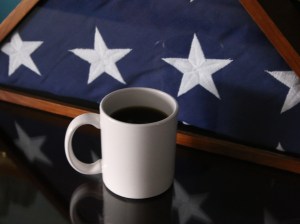
Frank lifted his cup in a goodwill toast. “Oh, I was just sitting here drinking my coffee.” He emptied the cup with a final sip to complete the toast.
“Would you like for me to take your empty cup back to the kitchen?” she asked.
“Oh no.” said Frank. “That won’t be necessary. The conductor will collect the empty cups and leave them at the next depot. The next eastbound train will carry them back to North Platte.”
S. E. Lash January 25, 2017
 Yesterday, our soon to be three-year-old grandson, Gabe, came to spend the day. He had been miserably ill the day before, was feeling a little better, but it in spite of his sickly appearance he brought a measurable amount of cheer into our home.



 that they just fly around from dusk to dawn, randomly flashing their little lights to entertain us and serve to be captured by children at the risk of being imprisoned in glass jars.The lightning bug however, doesn’t care about humans, and is not as concerned about feeding or protecting himself as he is about finding a hot date for the night.
 It was the last day of school for the year and I was on my way to attend Josh’s second grade class party. I was beginning to feel a smidgen of anxiety as I drew closer to the school building because: I was dressed up like Santa Claus and trying to drive as cautiously as possible to avoid being pulled over by the police for whatever reason, and I was a bit apprehensive about running a gauntlet of seven and eight year-olds with varying degrees of Santa belief. I knew of at least one kid in the class who had recently challenged the veracity of the Jolly Old Elf, and had most likely shared his skepticism with most of his classmates.
 Grampy Lash